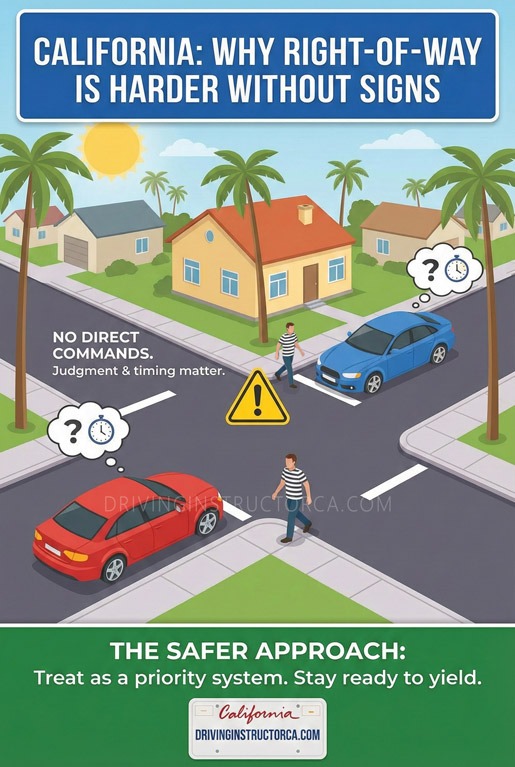
An uncontrolled intersection is an intersection with no stop signs or signals controlling the approach. You might see this in quiet residential areas, some rural roads, or private communities.
If two vehicles arrive at about the same time
A common rule of thumb applies: yield to the vehicle on your right when arrival is truly simultaneous. This is one of the few moments where a “direction rule” becomes the deciding factor.
Scenario: You approach a small intersection at the same moment as another car. You’re both slowing, neither has a sign, and neither is already entering. If the other vehicle is on your right, you yield. If you are on their right, they yield.
What matters here is timing. If one vehicle clearly arrives first and is already entering, it’s usually safer for the other to yield rather than trying to “balance” the situation.
If a driver is already crossing the intersection, the safer decision is to yield and let them clear the space. Even if you believe you had priority, entering at the same time creates a side-impact risk.
Pedestrians come first
At uncontrolled intersections, pedestrians often have the highest priority because they have the least protection and the slowest ability to adjust. If a pedestrian is crossing where drivers should reasonably expect crossing, you yield.
Scenario: You slow toward an uncontrolled intersection and see a pedestrian stepping off the curb into the crossing path. Even if no marked lines are present, your safest decision is to wait and let them cross fully.