California Lane Rules Explained: Choosing the Correct Lane and Avoiding Confusion

California lane rules can feel inconsistent at first because the “correct” lane depends on what the road is showing you right now—lines, arrows, lane drops, bike lanes, and how traffic is moving. That’s why many written-test questions depend on context. If you learn to read the pavement like a set of instructions, lane choices become much easier and more predictable.

This guide focuses on the lane rules that confuse new California drivers the most: basic lane positioning, left-lane expectations, turn-lane setup, freeway lane discipline, and the lane-marking details that change the answer.

Why Lane Questions Are Confusing on the DMV Test

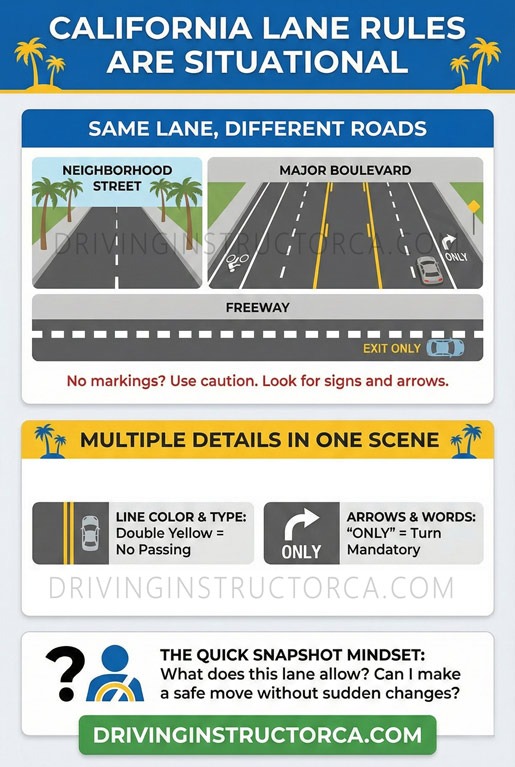
Lane questions are situational because the same lane can mean different things on different roads. A neighborhood street might have no markings at all. A major boulevard can have turn pockets, bike lanes, and arrows that turn a “normal” lane into a turn-only lane close to the intersection. A freeway may add an auxiliary lane that becomes an exit-only lane a short distance later.

Questions also combine multiple details in one scene:

  • line color (yellow vs white)
  • line type (broken, solid, double solid)
  • arrows and pavement words (“ONLY,” “EXIT,” “MERGE”)
  • whether traffic is merging, slowing, or flowing faster in one lane
  • what you plan to do next (turn, exit, continue straight)

When you answer, it helps to treat the question like a quick driving snapshot: What does this lane allow, and what move can I make safely without sudden changes? That mindset matches real driving and keeps the logic consistent.

California lane rules

Basic Lane Positioning Rules in California

These fundamentals apply across most California roads and show up often in DMV lane questions.

Stay within one lane and avoid drifting.
Even a small drift makes you harder to read. When you stay centered, other drivers can predict you more easily, which reduces sudden braking and last-second swerves around you.

Choose lanes based on your next move, not comfort.
If you need a right turn soon, begin working toward the right lane early. If you need a left turn soon, position toward the left lane early (while following signs and arrows). Waiting until the last moment turns a normal drive into a rushed decision.

Follow lane markings and arrows first.
Painted instructions override “habit rules.” If a lane has a turn-only arrow, it’s telling you how that lane is designed to move through the intersection. If you notice too late to change lanes safely, the safer choice is usually to follow your lane’s direction and re-route later.

How to read line colors quickly

A simple way to organize lane markings:

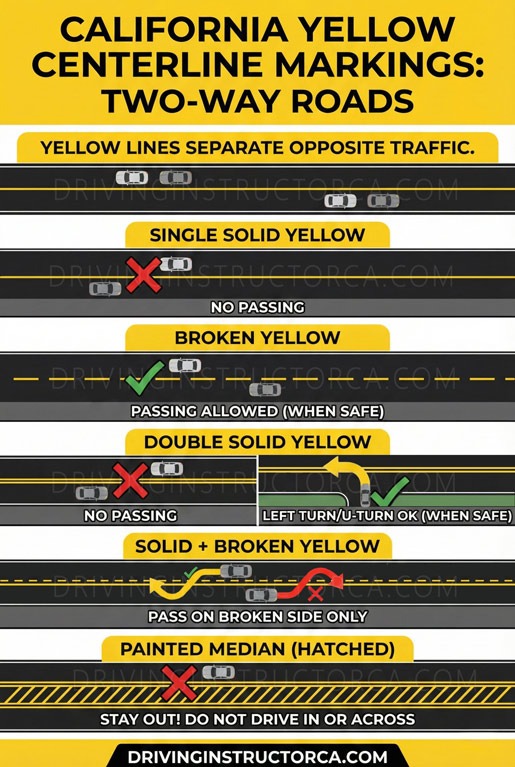
Yellow lines: usually separate traffic moving in opposite directions (common on two-way roads).
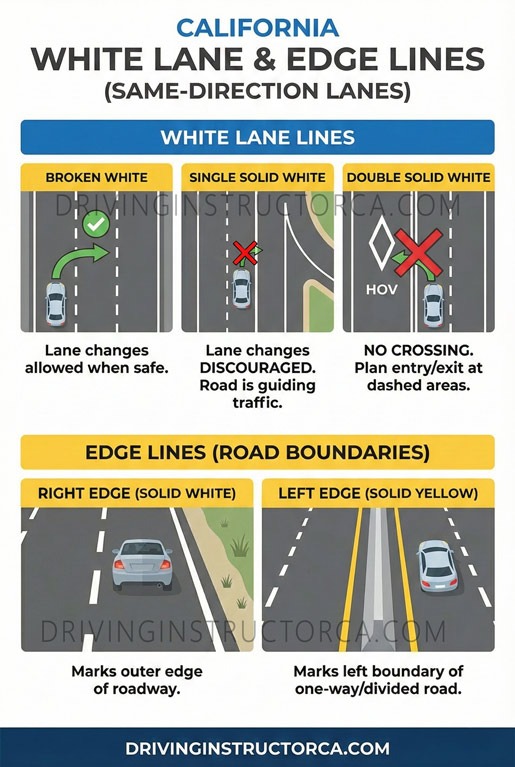
White lines: usually separate lanes moving in the same direction (multi-lane streets and freeways).

Then the line style adds meaning.

Yellow centerline markings (two-way roads)

  • Single solid yellow: marks the center; don’t cross it to pass.
  • Broken yellow: passing can be allowed when you have enough visibility and space to complete the pass and return safely.
  • Double solid yellow: don’t cross to pass in either direction. However, you can still cross to make a legal left turn into or out of a driveway or side road (and a U-turn only where permitted and safe).
  • Solid + broken yellow: only the side with the broken line may cross to pass; the solid side should not.
  • Painted median / hatched buffer between yellow lines: treat it like a divider area you stay out of. If a turn is allowed, you usually do it through a designated opening—not by driving along or through the striped area.
California lane rules

White lane lines (same-direction lanes)

  • Broken white: lane changes are typically allowed when safe.
  • Single solid white: used where lane changes are discouraged because the road is guiding traffic (near merges, exits, or narrow areas). Even if a lane change might be possible in some situations, it’s usually not the smart place to do it.
  • Double solid white: used where crossing is not allowed (commonly between HOV/express lanes and regular lanes, and in some freeway segments). Plan entry/exit where markings become dashed.

Edge lines (road boundaries)

  • Right edge line (solid white): marks the outer edge of the roadway and helps drivers avoid drifting off the road.
  • Left edge line (solid yellow in some places): can mark the left boundary of a one-way or divided roadway in certain designs.

Left Lane Rules: Passing, Traffic Flow, and Common Misunderstandings

The left lane is confusing because people learn it as a slogan instead of a lane-use pattern.

On many highways, the left lane is mainly used for passing.
In typical freeway flow, drivers use the far-left lane to overtake slower vehicles, then return to a lane that matches their steady speed. This reduces passing on the right and keeps the traffic pattern more stable.

Traffic flow matters, not just the posted number.
If you’re not passing and vehicles stack behind you, you become the “slow point” in a faster lane. That often leads to tailgating and quick lane changes around you. A calmer approach is: pass when needed, then move right when you’re done and it’s safe.

When slower travel in the left lane can still make sense.
Not every situation is “fast left lane.” Congestion can slow all lanes. You might be setting up for a left exit or a left-side merge. In those cases, the goal stays the same: drive predictably, avoid abrupt lane changes, and keep your spacing consistent.

Why lingering causes problems.
New drivers sometimes stay left because they feel away from right-side driveways or merging. On faster roads, that choice can create more conflict than it prevents. If others start passing you on the right, you end up surrounded by lane changes.

A quick self-check helps:

  • Am I actively passing?
  • Am I preparing for a left exit/left-side move soon?
  • Is the freeway moving slowly in every lane?
    If none apply, moving right when safe usually fits lane positioning California expectations better.

Choosing the Correct Lane for Turns and Intersections

This section is exam-heavy because intersections force you to commit to a lane.

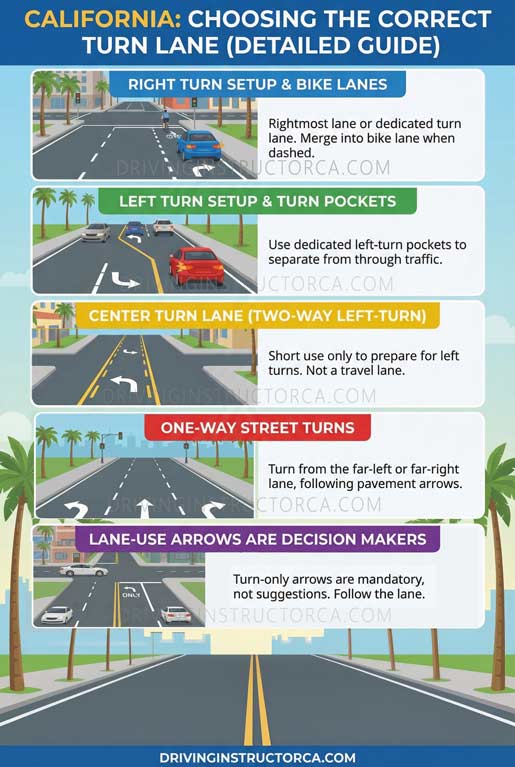
Right turns: set up from the rightmost lane for your direction of travel.
Most of the time, you turn right from the right lane (or from the right side of a single lane). What changes the answer is the road design: a dedicated right-turn lane, arrows, or a bike lane next to the curb.

Left turns: set up from the leftmost lane for your direction of travel.
If there’s a dedicated left-turn pocket, use it when it’s available and safe. Turn pockets exist to separate turning cars from straight-through traffic so everyone can move more smoothly.

Center turn lanes (two-way left-turn lanes): short use only.
A shared center turn lane is not a travel lane. You enter it to prepare for a left turn into a driveway or side street, then complete the turn. DMV lane questions often test whether you use it for its intended purpose rather than “driving in it.”

One-way streets change the setup.
On a one-way street, you may turn left from the far-left lane and right from the far-right lane. Still, arrows and signs can assign special turn lanes, so read the pavement first.

Lane-use arrows and pavement words are decision makers.
If your lane shows a turn-only arrow, it’s not a suggestion. If you realize late, the safest option is usually to follow your lane and adjust your route later, not cut across near the intersection.

One more practical rule: even when something isn’t described as “illegal” in a question, changing lanes inside an intersection is a poor plan because space is tight and drivers around you are focused on their own turns and signals. Set up before you enter.


Multi-Lane Roads, Highways, and Lane Discipline

Freeway driving depends on predictable movement more than aggressive lane changes.

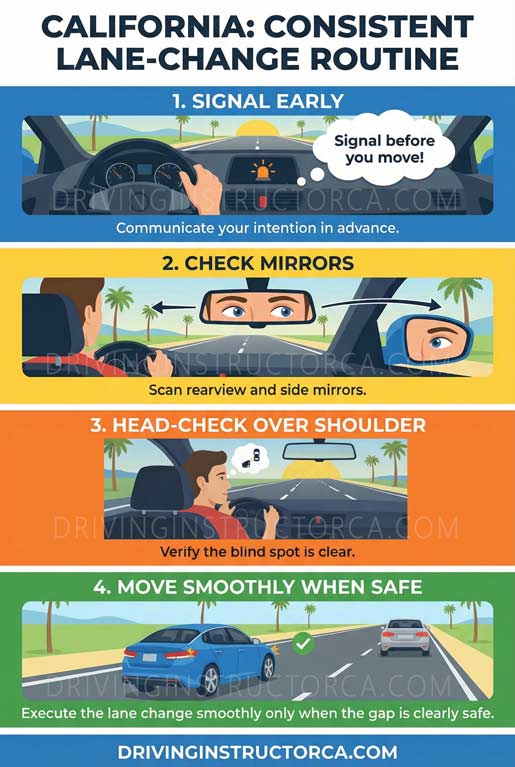
Use a consistent lane-change routine.
Many instructors teach an easy sequence:

  • Signal early
  • Check mirrors
  • Head-check over the shoulder for blind spots
  • Move smoothly when the gap is clearly safe

That routine matters because mirrors don’t show everything, especially motorcycles and fast-approaching cars.

Give yourself real space.
On DMV lane questions, the safe answer usually avoids forcing another driver to brake. In real traffic, you want enough room that you can move over smoothly without “squeezing” into a tight gap.

Change lanes one at a time.
Crossing two lanes in a single move is harder for others to read and leaves you fewer escape options. Move one lane, stabilize, then reassess.

Understand lane drops and channelized areas.
Large dashed white lines often signal a lane ending. Buffer zones with diagonal striping guide merging and exiting traffic. Treat those striped areas as places you stay out of, and merge early instead of waiting until the last second.

This is also where speed limits and lane rules often work together in real driving situations. If you haven’t read it yet, our guide on speed limits and common misunderstandings helps connect lane choice with safe speed decisions.

Common DMV Lane-Related Traps and Misunderstandings

These aren’t “trick questions.” They’re common misunderstandings that lead to the wrong answer.

Misunderstanding: Waiting too long to get into the correct lane.
If you need to turn or exit, scenario questions usually favor early lane selection and steady driving over last-second changes.

Misunderstanding: Ignoring turn-only arrows because the lane looks normal.
The arrow is often the deciding detail. If you’re in a turn-only lane, the safe plan is to follow it unless you can change lanes safely well before the intersection.

Misunderstanding: Treating solid white lines like broken white lines.
A single solid white line often marks a place where lane changes are discouraged because traffic is being organized. Double solid white lines are a stronger “do not cross” signal. If a question includes double solid white, assume you should not cross it.

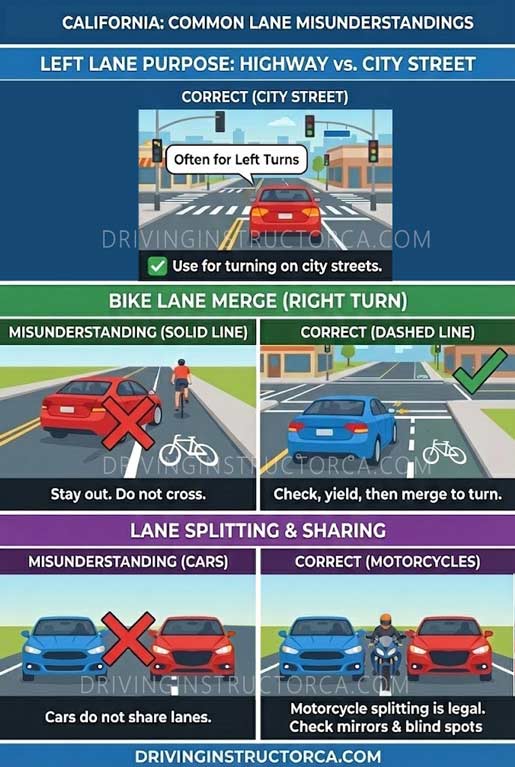
Misunderstanding: Assuming every left lane is the same everywhere.
Left lane rules California drivers talk about most often apply to highways. On city streets, the left lane may be the correct place to set up for a left turn, not a “passing lane.”

Misunderstanding: Not recognizing bike lane patterns near right turns.
If the bike lane line becomes dashed near an intersection, that usually signals a merging area where you may move into the bike lane space to prepare for a right turn—after checking carefully and yielding to cyclists. If the line stays solid, don’t drift into it early.

Misunderstanding: Confusing lane splitting and lane sharing.
Passenger vehicles should not share a lane side-by-side. California allows motorcycle lane splitting under CVC §21658.1. For drivers, the key test logic is awareness: check mirrors and blind spots before changing lanes, especially in slow traffic.

How to Practice Lane Questions Effectively

Lane rules become reliable when you practice them as mini-scenarios. When you study, force yourself to identify the one detail that controls the answer:

  • the lane arrow (turn-only vs straight/turn)
  • the line type (broken vs solid vs double solid)
  • pavement words (“ONLY,” “EXIT,” “MERGE”)
  • a lane drop or striped buffer zone
  • a bike lane next to your turn

A strong habit is asking: “What should I have done earlier?” Many DMV lane questions are really testing planning: choose the correct lane in advance, then keep your movement predictable.

If you want focused practice, start here: practice California lane rule questions. The more you practice with real road scenes, the more naturally California lane rules will click—both on the test and in everyday traffic.