
Parking Rules in California: Curb Colors, Hills, and Common DMV Confusion

Parking rules in California feel simple until you start noticing how many details can change the answer. A curb might be painted, faded, or split into different colors. A “quick stop” might be treated differently depending on whether you are loading, dropping off, blocking access, or sitting too close to an intersection corner. That’s why parking rules show up often in written questions: questions often depend on multiple details, not one obvious clue.

This guide explains the parking rules that confuse new drivers most—curb colors, hill parking logic, and distance-based restrictions—using practical examples and the kind of situations you see in real neighborhoods.
Why Parking Questions Are Confusing on the DMV Test

Parking questions are confusing because they rarely involve just one factor. In real life, people often park based on habit: “I’ve parked here before,” or “Everyone parks here.” But the written test focuses on whether you can spot the combination of details that makes a spot legal or restricted.

A few reasons confusion happens fast:

  • Same curb does not mean the same rule everywhere. A green curb in one area might have different time limits posted than another green curb across town.
  • Signs, colors, and distances work together. Paint might suggest one thing, but a posted sign can narrow or change what’s allowed.
  • Parking rules are tied to visibility and access. Many restrictions exist to keep sight lines open for drivers and safe space available for pedestrians and emergency needs.

Instead of trying to memorize a long list, it helps to think like this: What problem would parking here create? If it blocks a view, blocks an entrance, or removes space other road users rely on, it’s probably restricted.

Curb Colors in California and What They Signal

Curb paint is one of the fastest ways cities communicate parking limits. The challenge is that color is only one layer. Time-of-day signs, local rules, and loading rules can still apply.

Here’s what each curb color generally indicates and where drivers often make the wrong assumption.

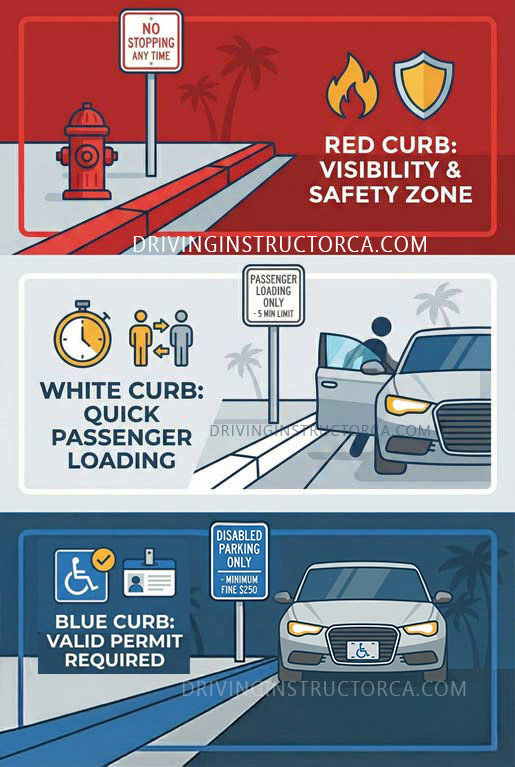
Red curb

A red curb signals that stopping along that section is not allowed for normal parking or waiting. Drivers sometimes treat red like “just for a minute,” but red is meant to keep an area clear—often near corners, fire lanes, or zones where visibility needs to stay open.

Where it confuses drivers:
A red curb near an intersection may look like extra space, especially when traffic is light. But that open space is often there so drivers pulling out can see cross traffic and pedestrians.

White curb

White is commonly used for passenger loading and unloading. Think quick pick-up or drop-off, not extended waiting. In many areas, white curbs are time-limited and focused on passengers, not general parking.

Where it confuses drivers:
Drivers assume “loading” includes sitting in the car for a long time. In exam-style questions, white curbs usually imply a brief stop tied to passengers.

Blue curb

Blue indicates parking reserved for people with disabled placards or plates. This is one of the clearer colors, but confusion still happens when the paint is faded or when the space is next to a normal curb.

Where it confuses drivers:
Some drivers see a mostly faded curb and assume it “doesn’t count.” On the test, faded paint is still treated as a restriction clue, especially when signage supports it.

parking rules in California

Green curb

Green curbs allow parking, but only for a limited time. The goal is turnover—short stays that keep spaces available for errands or quick visits.

Where it confuses drivers:
Drivers assume green means “free parking.” It is not “free” in the sense of unlimited time. The time limit is the point.

Yellow curb

Yellow is typically used for loading zones—often for commercial loading, deliveries, or active loading/unloading. In many places, passenger vehicles may be allowed to stop briefly for loading, but the idea is that the zone is meant to stay available for active loading, not long-term waiting.

Where it confuses drivers:
People treat yellow as “close parking” because it’s near a storefront. On the exam, yellow usually signals limited use tied to loading activity.

Why signs can override paint

A painted curb is a strong clue, but signs can add limits like hours, days, vehicle type, or special rules during street cleaning. If a question gives you a curb color and a sign, treat the sign as the “final instruction.”

Parking on Hills: Wheel Direction and Vehicle Control

Hill parking is tested often because it’s a safety rule, not a convenience rule. The goal is simple: if the vehicle rolls, the wheel position helps keep it from rolling into traffic.

The wheel direction matters because the curb (or the edge of the road) can act like a stop. Setting the wheels correctly helps the car roll into a safer position instead of rolling freely downhill.

Uphill with a curb

Turn the front wheels away from the curb.
If the vehicle rolls backward, the wheel angle guides the tire into the curb, helping stop the vehicle.

Uphill without a curb

Turn the front wheels toward the edge of the road.
Without a curb to catch the tire, you want the vehicle to roll away from traffic if it moves.

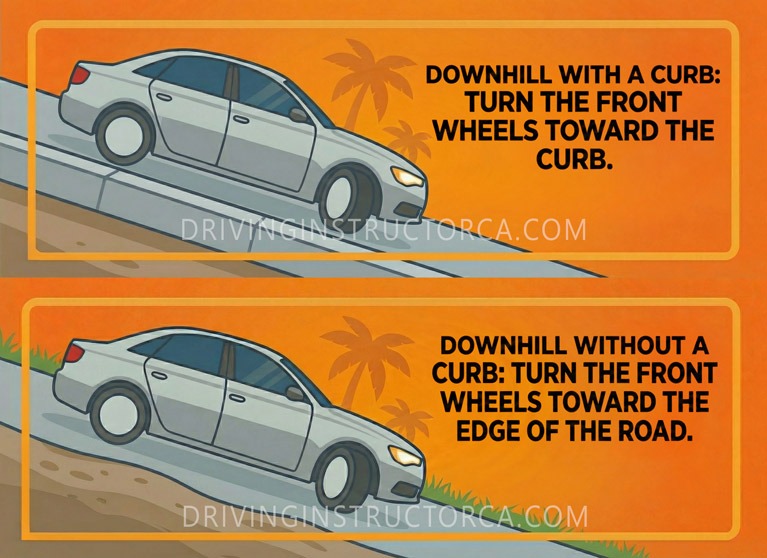
Downhill with a curb

Turn the front wheels toward the curb.
If the car rolls forward downhill, the wheel angle guides the tire into the curb.

Downhill without a curb

Turn the front wheels toward the edge of the road.
With no curb, you again want the vehicle to roll away from the main travel path if it moves.

Common confusion point:

Drivers sometimes think the rule changes based on whether the engine is on. Hill wheel positioning is about what happens if the vehicle moves unexpectedly—so the logic stays the same.

Distance-Based Parking Restrictions

Many California parking restrictions are about keeping clear space near key areas—so drivers can see, pedestrians can cross, and access points stay usable. These rules show up on tests because they require spatial judgment.

Near fire hydrants

Parking too close to a hydrant creates a huge access problem in an emergency. On the test, expect questions that ask you to recognize that hydrant space must stay open.

Practical tip:
If you notice a hydrant, treat it like a “no-parking bubble” around it, even if you think you can squeeze in.

Near crosswalks

Crosswalk areas need visibility. Parking too close can hide pedestrians until the last moment. Even when crosswalk markings are faint, corners and pedestrian crossing areas are treated as high-visibility zones.

Near corners and intersections

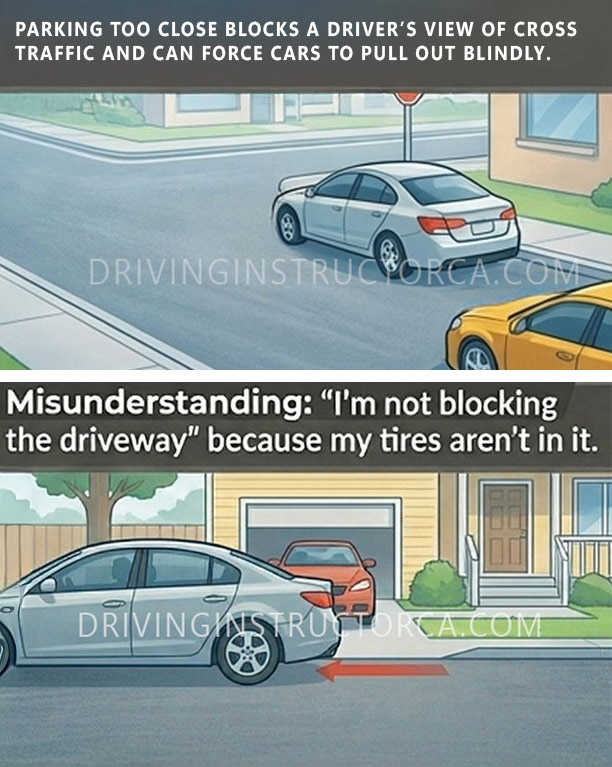
Corners are one of the biggest visibility trouble spots. Parking too close blocks a driver’s view of cross traffic and can force cars to pull out blindly.

This connects directly to how right-of-way plays out in real driving. If sight lines are blocked, drivers can’t yield correctly. That’s why visibility rules and movement rules work together. If you want more context on how visibility affects who yields, see:
Right-of-Way in California: Who Yields When There Is No Stop Sign

Near driveways

Even if a spot looks open, parking in a way that blocks a driveway—fully or partially—creates an access issue. Many questions test whether you recognize that “not touching the driveway” isn’t enough if the car still prevents entry or exit.

Why distance matters on the exam

The DMV-style logic is usually based on what your vehicle blocks:

  • a driver’s view
  • a pedestrian crossing area
  • an emergency or access point

When you picture the view from a driver pulling out or the path of a pedestrian, the correct answer becomes easier.

Temporary Restrictions and Situational Limits

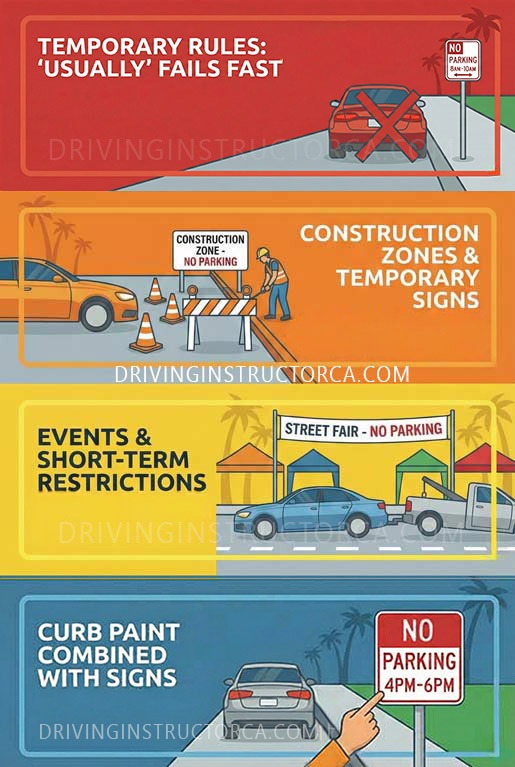
Temporary rules are where “I usually park here” logic fails fast. Parking may be allowed most days, but restricted during certain hours or special conditions.

Construction zones and temporary signs

Construction can change curb use, remove lanes, or create new loading and access needs. Temporary signs may restrict parking even if the curb color normally allows it.

Events and short-term restrictions

Stadium events, street fairs, filming, and community events can create temporary “no parking” zones. A spot that’s normally fine can become restricted due to safety and traffic flow.

Curb paint combined with signs

A common exam pattern is giving you:

  • a curb color that suggests one rule
  • a posted sign that changes it (hours, days, vehicle type)

When both appear, the safest approach is to follow the sign as the more specific instruction.

parking rules in California

Common DMV Parking Misunderstandings

These are misunderstandings, not “bad driving.” They happen because parking feels casual in real life.

Misunderstanding: Green means unlimited parking.
Green is typically short-term parking. The time limit is the point of the color.

Misunderstanding: Hill rules only matter if the car is running.
Wheel direction is about preventing a roll, not about engine status.

Misunderstanding: Faded paint means no rule.
Faded paint still signals intended restriction, especially when other clues support it.

Misunderstanding: “I’m not blocking the driveway” because my tires aren’t in it.
Blocking is about access, not whether your wheels cross a line.

Misunderstanding: Parking can be legal but still create a hazard.
Even if a spot isn’t clearly marked, if your vehicle blocks visibility near a corner or forces others to squeeze around you, exam questions often treat that as a poor choice.

Practice This Rule in Real DMV-Style Questions

Parking rules are tested through scenarios that combine curb colors, signs, visibility, and distance limits.
Practice California DMV questions that focus on parking legality and real-world situations.

How to Practice Parking Questions Effectively

Parking questions are easier when you practice visually. The best practice questions show a curb, a sign, and a nearby feature like a hydrant or corner, and then ask what is allowed.

A strong method is:

  1. Identify curb color (if any)
  2. Read the sign details (hours, vehicle type, limits)
  3. Scan for distance-based conflicts (hydrant, corner, crosswalk, driveway)
  4. Decide what the parking position would block

To practice with scenario-style questions, start here:
practice California parking questions

Real driving situations are easier to master with guided practice and feedback.

Parking rules in California become much clearer when you stop treating them as random restrictions and start viewing them as visibility and access rules. Once you learn to combine curb colors, signs, and nearby features, the confusing questions become much more predictable.