
Solid and Broken Lines in California: What Each Marking Actually Allows

Solid and broken lines in California exist for one reason: to control how risk is managed on the road. They are not there to describe the road — they are there to limit uncertainty between drivers. When you understand that purpose, the markings stop feeling random and start making sense.

What confuses many new drivers is expecting a line to give a single answer. In reality, a line sets boundaries, and your decision depends on where you are, what traffic is doing, and what move you are about to make. That same logic is reflected in how these markings appear on the written exam.
Why Road Marking Questions Cause Confusion

Road marking questions are misunderstood because drivers expect markings to work like signs: one symbol, one rule. Lines don’t work that way. A line controls space, not behavior.

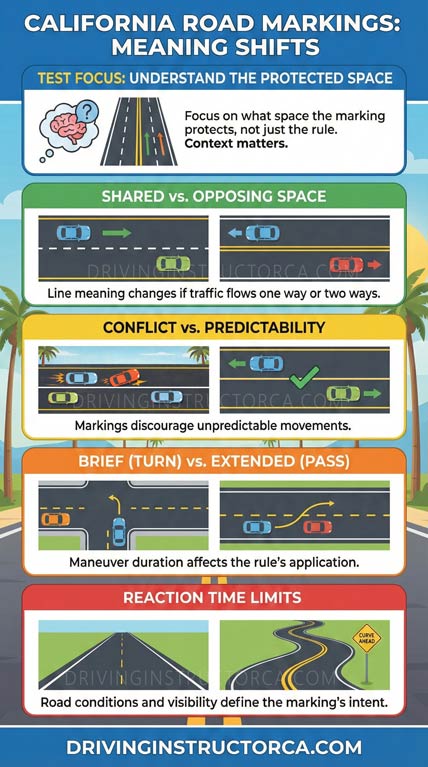
On the written test, questions often ask whether a driver recognizes what space the road is protecting, not whether they remember a rule word-for-word. A marking might allow a maneuver in one moment and discourage it in the next, even though the paint looks the same.

Meaning shifts based on:

  • whether the line divides shared space or opposing space
  • whether movement would create conflict or predictability
  • whether the maneuver is brief (turning) or extended (passing)
  • whether the road ahead limits reaction time

That’s why a reliable approach is to ask:
What problem is this line trying to prevent right here?

Yellow Lines vs White Lines: Direction Changes Everything

Before looking at whether a line is solid or broken, first look at who occupies the space on the other side.

Yellow markings appear where traffic approaches from opposite directions. Any movement across a yellow line introduces head-on risk, which is why yellow markings focus heavily on visibility and timing.

White markings separate lanes moving together. Here, the risk is not collision with oncoming traffic, but disruption of flow — sudden braking, weaving, or merging conflicts.

Many wrong answers come from ignoring this difference. A broken white line does not invite passing into another direction. A broken yellow line does not organize same-direction lanes. Each color signals a different type of risk the road is managing.

Broken Lines: Flexibility With Conditions

Broken lines allow movement, but they do not promise a good outcome.

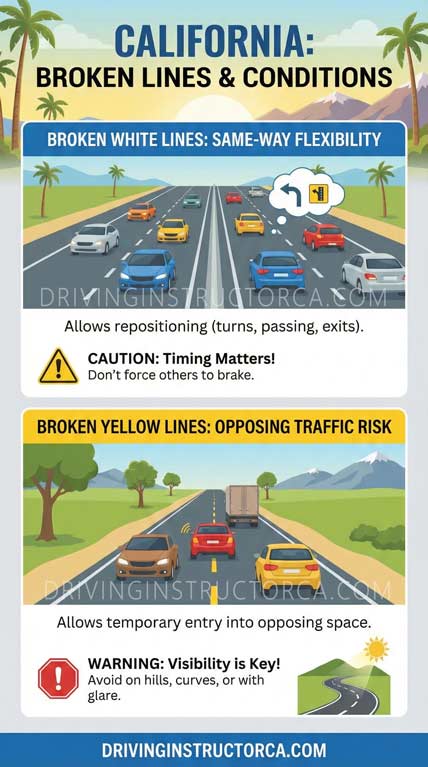
A broken white line allows drivers to reposition within traffic moving the same way. This includes preparing for turns, moving around slower vehicles, or adjusting for exits.

What exam questions often test is timing, not legality. If traffic is tight or a lane is ending, the safer decision may be to wait. A permitted lane change that forces another driver to brake is usually the wrong choice in both real driving and test logic.

A broken yellow line allows a driver to temporarily enter opposing space — but only when the road ahead offers enough time to complete the move and return safely.

Visibility matters more than speed here. Hills, curves, glare, and parked vehicles shorten decision time dramatically. On questions, the broken yellow line explains why passing could exist, but the scene explains why it might still be unwise.

solid and broken lines in California

Solid Lines: Stability Over Movement

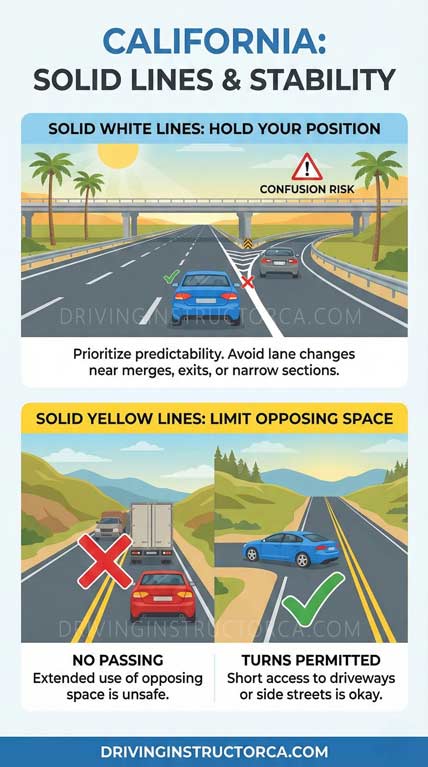
Solid lines appear where the road prioritizes predictability.

A solid white line is commonly used where the road design needs drivers to hold position — near merges, exits, or narrow transitions. It signals that lateral movement would create confusion or sudden braking.

A single solid white line does not function the same way everywhere, but it consistently communicates restraint. On exam questions, the safest answers usually respect that restraint rather than testing its limits.

A solid yellow line limits extended use of opposing space. Passing across it would require too much time in oncoming traffic, especially where visibility is restricted.

However, roads still need access points. That’s why solid yellow lines exist alongside turning movements in real life. The marking limits how long you occupy opposing space, not whether turning is possible at all.

Double Lines and Direction-Based Patterns

This is where many drivers get stuck — and where exams often focus.

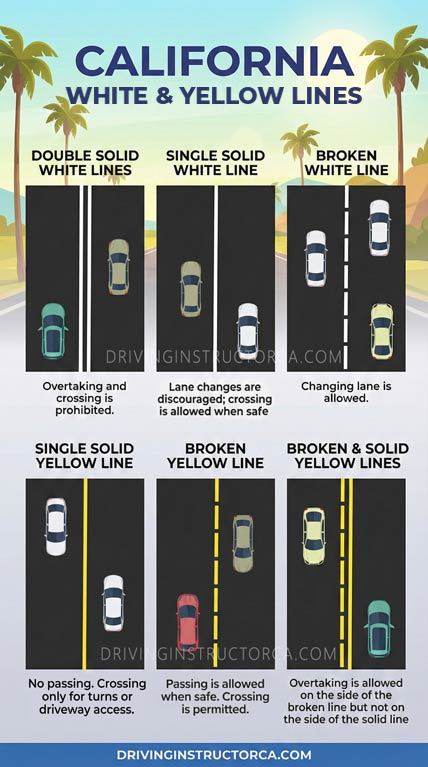
Double solid yellow lines restrict passing in both directions. They are used where any extended crossing would expose drivers to unacceptable risk.

They do not automatically remove the need for left turns. The exam distinction is whether the driver is crossing briefly to change direction or attempting to travel alongside opposing traffic.

Solid and broken yellow together

When one side is solid and the other broken, the road is managing uneven visibility.

  • Drivers next to the broken line may have enough sight distance to pass.
  • Drivers next to the solid line do not.

The paint is directional. On test questions, imagine sitting in the lane and ask which line is closest to your tires.

Double solid white lines create firm lane boundaries, often between regular lanes and special-use lanes. Crossing them breaks the road’s intended traffic organization.

When these appear in questions, the correct reasoning usually involves waiting for a designated opening rather than forcing an early entry or exit.

solid and broken lines in California

Turning, Passing, and Crossing: Not the Same Decision

Many misunderstandings come from treating all line crossings the same.

Turning across yellow lines

Turning requires brief use of space, not continued travel. That’s why left turns across yellow lines exist throughout California roads.

What matters is how the turn is executed: signaling early, slowing gradually, yielding correctly, and completing the turn cleanly without drifting wide.

Passing is different

Passing requires extended use of space that belongs to opposing traffic. That’s why passing rules are stricter and more dependent on visibility and distance.

On exam questions, verbs matter. “Pass,” “overtake,” or “go around” trigger passing logic. “Turn into,” “enter,” or “access” trigger turning logic.

White line crossings

With white lines, the decision usually comes down to flow, not danger. A lane change may be allowed, but poorly timed changes create congestion and sudden braking.

This is where lane rules and road markings work together when choosing the correct lane, especially near intersections and exits. Related explanation here: California Lane Rules Explained

Common DMV Road Marking Misunderstandings

“If it’s broken, I can cross.”
Broken lines allow movement, not urgency.

“If it’s solid, I can’t cross at all.”
Solid lines limit extended movement, not all access.

“Color is secondary.”
Color defines the type of risk involved.

“Both sides follow the same rule.”
Mixed yellow patterns apply differently by direction.

“Markings are flexible.”
Many are designed to prevent last-second decisions.

“Only the line matters.”
The surrounding scene often determines the correct answer.

How to Practice Road Marking Questions Effectively

The fastest way to master solid and broken lines in California is to stop studying them as symbols and start studying them as risk controls.

Use this sequence:

  1. What space is the road protecting?
  2. Who occupies the space on the other side?
  3. Is the movement brief or extended?
  4. Does the situation allow enough time?

For realistic scenario practice, use:
👉 practice California road marking questions

When you read markings as tools that manage space and reaction time, the rules become consistent — both on the written exam and in real traffic.